AI agents have crossed from experiment to operating layer. Here’s what that means for every business that serves a customer — and the rules that now define who wins.
| $15.1B AI customer service market size in 2026 | 56% of support interactions involve agentic AI by mid-2026 | $3.50 average ROI for every $1 invested in AI service | 80% of routine interactions fully handled by AI in 2026 | $0.62 avg cost per AI-resolved ticket vs $7.40 for humans |
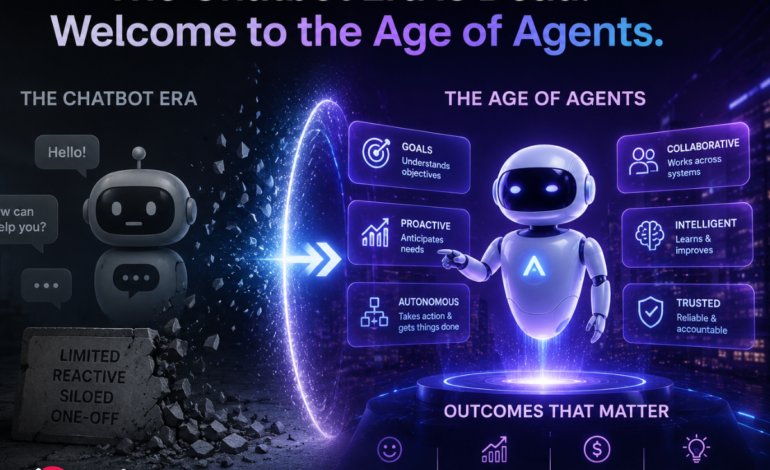
Something fundamental shifted in customer experience in 2025. Not a technology upgrade — a category change. The chatbot era, defined by brittle scripts and canned responses that infuriated as often as they helped, is effectively over. What replaced it isn’t just smarter automation. It’s agency: AI systems that can reason, remember, decide, and act. The companies that understand this shift — and rebuild their CX accordingly — are pulling ahead fast. Those that don’t are discovering, one frustrated customer at a time, that the old rules no longer apply.
The “Bot or Human” Binary Is Dead — Design for the Spectrum
For years, the central question in CX strategy was deceptively simple: automate it, or have a human handle it? Companies drew bright lines. Chatbots got the trivial stuff. Humans got everything else. The result was a system that worked fine on the easy end and broke badly in the middle.
Agentic AI has dissolved that binary entirely. Today’s AI agents don’t just answer — they reason across context, connect to backend systems, execute multi-step workflows, and hand off to humans with full context intact. The question is no longer who handles the interaction. It’s how much autonomy is appropriate for this particular moment in this particular journey.
| 88% | of contact centers now use AI in some capacity — yet only 25% have fully integrated automation into daily workflows. The gap between adoption and integration is where competitive advantage lives in 2026. — AmplifAI State of Customer Service 2026 |
The companies winning in this new landscape have stopped thinking about automation as a cost-reduction lever and started thinking about it as an experience architecture decision. Every interaction has a natural point of maximum AI leverage and a natural point where human presence becomes essential. The job of modern CX design is to find both — and connect them seamlessly.
| “Customers don’t experience channels. They experience problems. The channel is just whatever feels fastest in that moment.” — Synthflow State of Customer Experience 2026 |
Speed Is the Table Stakes. Memory Is the Differentiator.
Response time used to be a competitive advantage. It no longer is — it’s now a minimum viable expectation. The evidence is striking AI has reduced average first response times from over six hours to under four minutes, and resolution times from 32 hours to 32 minutes. Bank of America’s Erica resolves 98% of queries in under 44 seconds. Klarna’s AI cut average issue resolution from 11 minutes to 2 minutes. H&M’s generative AI chatbot reduced response times by 70%.
When your competitors can do all of this too, speed stops being your edge. What separates the exceptional from the merely fast is something far harder to build: memory and continuity.
| Dimension | Old World: Ticket-Based | New World: Memory-Rich Agents |
| Every interaction starts from zero | Customer re-explains their situation each time | Agent recalls context, tone, history, preferences |
| Context lost at every channel switch | AI handles the moment; humans own the relationship | Unified profile spans all channels seamlessly |
| Resolution measured in tickets closed | Interactions are siloed episodes | Success measured in customer outcomes, not tickets |
Here’s a data point that makes this visceral: 48% of customers say they would abandon a brand if forced to re-explain their issue after being transferred to a human agent. Another 40% would leave if asked to re-verify their identity. The worst handoffs aren’t the slowest ones — they’re the ones that erase everything the customer already told you.
The Trust Paradox: Customers Want AI — Just Not When They Don’t Know They’re Getting It
The data on customer attitudes toward AI contains a sharp internal contradiction that every CX leader needs to grapple with. On one hand: 69% of consumers now prefer AI-powered self-service for quick issue resolution. 74% prefer chatbots for simple questions. But simultaneously: 64% would prefer companies didn’t use AI at all. 53% would consider switching to a competitor if they discovered a brand was using AI in their service.
These numbers don’t cancel each other out. They describe the same truth from two different angles: customers want the benefits of AI, but they want to feel in control of the encounter.
| 43% | of customers would willingly interact with a brand’s AI concierge — if offered transparently. The same customers often disengage when they discover unexpected AI involvement. Trust isn’t about technology; it’s about agency. — Adobe 2026 AI and Digital Trends Report (4,000 customers surveyed) |
Adobe’s 2026 research frames it perfectly: customers draw clear lines around where they are willing to let AI play a role, especially when experiences move from convenience into privacy and decision-making. Comfort peaks for routine, low-risk uses. It falls sharply when AI touches financial decisions, health information, or sensitive personal data.
| “The most important customer trust factor is the ability to switch to a human at any time. Not the quality of the AI. Not the speed. The exit.” — Adobe 2026 AI and Digital Trends Report |
Personalization Is No Longer a Marketing Feature — It’s the Service Itself
The word “personalization” once meant putting a customer’s name in the subject line of a marketing email. Today it means something orders of magnitude more substantive: an AI agent that understands your history, anticipates your needs, adapts its communication style in real time, and proactively reaches out before you know you need help.
The expectations are staggering. 73% of shoppers now expect brands to understand their unique needs. 71% expect tailored interactions. 76% express frustration when companies miss that mark. And 59% of consumers believe companies have lost touch with the human element of customer experience.
| Personalization Capability | Business Outcome | Source |
| Hyper-personalized AI interactions | 80% of consumers feel more valued | Master of Code Global |
| B2B agentic AI implementation | 65% report stronger client engagement | Master of Code Global |
| AI-enabled agent tools (human agents) | 65% say AI frees time for relationship-building | AmplifAI 2026 |
| Personalized AI interactions overall | +6.7% average CSAT boost | Master of Code Global |
| Improving agent satisfaction through AI | +62% potential CSAT improvement | AmplifAI 2026 |
The Economics Have Flipped — But Cutting Humans Entirely Is a Trap
The cost math is now unambiguous. An AI-resolved customer interaction costs an average of $0.62. A human-resolved one costs $7.40 — nearly 12x more. Gartner estimates AI will eliminate $80 billion in contact center labor costs by the end of 2026. The global AI customer service market will reach $15.12 billion in 2026, growing at a CAGR of 25.6% through 2034.
Companies are reacting to this math aggressively. Gartner predicts organizations will replace 20–30% of service agents with generative AI by 2026. And yet — here’s the trap — 50% of organizations that planned workforce reductions are expected to abandon those plans. Meanwhile, 95% of customer service leaders say they plan to retain human agents.
Why? Because pure-AI handling lands at 4.1/5 CSAT against 4.3/5 for human agents. That gap seems small — until you remember that 52% of customers will pay more for better service, and that 17% of customers say current AI support delivers no benefit whatsoever.
| $3T | in global sales are at risk from poor customer experience annually. Poor CX isn’t just a service problem — it’s a revenue problem of civilizational scale. Every friction point has a dollar figure attached to it. — AmplifAI State of Customer Service 2026 |
The winning economics model isn’t maximum automation — it’s right-fit automation. AI owns the 55–60% of inbound volume that is structured tier-1 traffic: order status, password resets, billing questions. These deflect at 65–80% accuracy. Human agents own the 35–40% that is emotionally charged or judgment-dependent.
Proactive Service Is the New Reactive Service — Anticipation Wins Loyalty
The old model of customer service was fundamentally reactive: wait for a problem to be reported, then solve it. Every interaction was, by definition, a failure state — something had already gone wrong. Agentic AI makes this model not just inefficient but strategically obsolete.
Modern AI agents can detect emerging problems before they escalate, identify at-risk customers from behavioral signals, trigger proactive outreach at the right moment, and resolve issues before the customer even knows they exist. Airlines use AI to proactively reroute passengers before flight disruptions become crises. SaaS companies detect customers approaching churn before they disengage.
- Flag problems before escalation. Agentic systems monitor signals — slow delivery, payment failure, error codes — and act before the customer contacts you.
- Personalize proactive outreach. Knowing a customer’s history allows agents to time outreach precisely and frame it in terms of their specific situation, not a generic template.
- Reduce ticket volume through prevention. Brands using integrated feedback loops are seeing ticket volume reductions of up to 50%.
- Use AI to summarize and learn, not just respond. Every conversation contains signal. AI agents that log and tag interactions generate a feedback loop that makes the whole system smarter over time.
The Handoff Is a Moment of Truth — Nail It or Lose Everything
Here is where the theory of agentic AI most often collides with operational reality. Capgemini’s Rise of Agentic AI report found that only 2% of organizations have deployed AI agents at scale, and trust in fully autonomous agents has actually declined as deployments move from pilot to production. The failure, consistently, happens at the handoff.
When an AI agent reaches the limit of its capability and transfers to a human, two things can happen. In the good version: the human arrives already equipped with full context. In the bad version — which is the current reality for most companies — the context disappears. The customer repeats everything. The trust the AI built evaporates in seconds.
| “The worst handoffs aren’t the slowest ones. They’re the ones that erase everything the customer already told you.” — Gladly, Agentic AI Customer Service 2026 |
Designing handoffs should be treated as mission-critical engineering, not an afterthought. The checklist: full context transfer (issue, history, emotion, what was tried); no identity re-verification; human arrival framed as progress, not failure; clear ownership of the resolution. Companies that get this right report that hybrid AI-human flows narrow the CSAT gap with pure human service to just 0.05 points.
Your Human Agents Are Now Your Scarcest Strategic Asset
Here’s an argument that runs counter to most of what you’ll hear about AI and the future of work: the widespread deployment of agentic AI does not reduce the importance of human agents. It increases it. Dramatically. When AI absorbs the high-volume, low-complexity interactions that previously consumed 55–60% of agent time, human agents are left with the work that actually determines whether customers stay or leave.
The problem is that most contact centers haven’t restructured for this reality. Their agents are stressed (87% report job-related stress), burning out (60%+ cite stress as their primary reason for leaving), and being replaced at enormous cost ($10,000 to $20,000 per agent to replace).
| 84% | of customer service representatives say AI makes responding to tickets easier — freeing time for work that requires human judgment. The agents who thrive in the agentic era aren’t threatened by AI; they’re empowered by it. — Salesforce State of Service |
The data makes the path forward clear. 65% of AI-enabled agents say AI gives them more time to build customer relationships. 90% of CX leaders report positive ROI from agent-facing AI tools. Service professionals using generative AI save over two hours daily. The companies positioning to win are investing in their human agents as strategic assets rather than overhead to minimize.
What the Next 36 Months Will Demand
Gartner’s long-range forecast is worth sitting with: by 2029, agentic AI will autonomously resolve 80% of common customer service issues without human intervention, driving a 30% reduction in operational costs. By 2028, 70% of customer service journeys will begin and end with third-party conversational assistants on mobile devices. By 2027, chatbots will become the primary customer service channel for roughly 25% of organizations.
Between now and those milestones, the organizations that execute well on the eight rules above will compound their advantages significantly. Those that treat AI as a cost-cutting exercise will discover the hard way that 53% of those customers are one bad experience away from a competitor.
The deepest shift isn’t technological. It’s philosophical. The companies rewriting the rules of customer experience aren’t asking “how much of this can we automate?” They’re asking “what experience do we want our customers to have — and what combination of AI and human capability delivers that best?”
| Eight Rules, One Principle Behind each of the eight rules explored here is a single underlying principle that the best CX organizations have internalized: AI changes the means of service, not its purpose. The purpose has always been to make customers feel understood, respected, and helped. Speed has always mattered. Memory has always mattered. Personalization has always mattered. What’s changed is that AI can now deliver these things at a scale and consistency that human-only operations never could — and at a cost that removes the old trade-off between quality and efficiency. Customers are not forgiving of brands that use AI to avoid them. They are remarkably loyal to brands that use AI to understand them. |